
Armenia cannot build a global wine industry on history alone
"We have more than 6,100 years of winemaking history" is a fact, not a fiction.
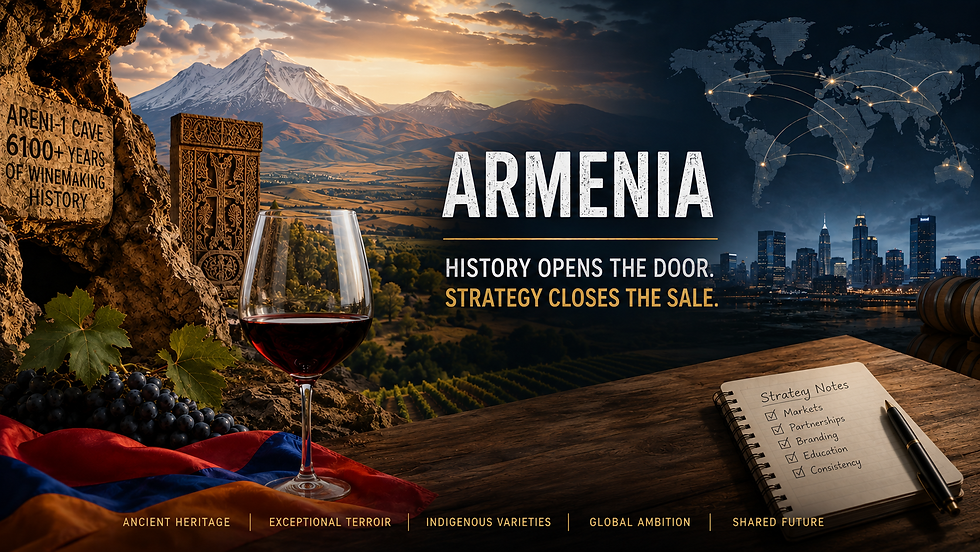
I say this as someone who built a winery in Armenia precisely because I believe in what that history represents. The Areni-1 cave. The indigenous varieties that survived Soviet collectivization. The volcanic soils at altitude that do things to a grape that you can't replicate anywhere else. I'm not dismissing any of it. I've staked sizable and many years on the premise that Armenian wine belongs on many tables around the world.
But I've also spent enough time in international markets to know how they actually work. And the honest answer is: they don't reward origin stories. They reward what's in the glass, whether they can get it reliably, and whether they understand what they're buying.
History opens the door. It doesn't close the sale.
What happens after the story lands
A sommelier in London hears that Armenia has been making wine for over 6,000 years. She's genuinely interested. That interest lasts about thirty seconds before the practical questions start.
Is it good? Can I get it here? What do I tell my guests about the grape variety they've never heard of? Is the price right for what it is? Will the next vintage be as good as this one?
Those questions are where wine industries are actually built — not in the vineyard, but in the ecosystem around the bottle. Distribution infrastructure. Importer relationships. Trade education. Packaging that communicates clearly on a shelf in a city where nobody grew up drinking Areni. Pricing that signals quality without pricing out the early adopters who could become the wine's best advocates.
Armenia is doing some of this. It's not doing enough of it. And the gap between the quality of what's being produced and the size of the market that knows about it is still very wide.
Recognition is momentum, not destination
Alexandrea Winery's Pinot Noir 2024 won a gold medal at Concours Mondial de Bruxelles this year. Armenia's first commercial Pinot Noir. First harvest. Gold medal. I'm proud of that result, and I think it matters for the industry beyond our winery.
But a medal is worth what you do with it.
If it leads to three more distribution conversations, two press placements, and a restaurant listing in a city where Armenian wine didn't exist before — it compounds. If it gets posted on Instagram and then filed away — it evaporates.
The mistake emerging wine regions make consistently is treating recognition as the goal rather than as fuel. Attention is temporary. What you build while you have attention is what lasts.
Every award, every positive review, every successful festival appearance should be feeding something: a new market, a new importer relationship, a new piece of trade education, a stronger narrative that the next journalist can work with. If the pipeline between recognition and positioning isn't built, you end up cycling through moments of excitement that never accumulate into a reputation.
The education problem nobody wants to talk about
Most international wine consumers can't pronounce Areni. They don't know what Voskehat tastes like. They don't have a mental map of Armenian wine regions the way they have one for Burgundy or Napa or even Georgia at this point.
That's not a criticism. It's the starting condition for any emerging wine region, and there's only one way through it: systematic, sustained market education.
Which means producers explaining the grapes on the back label in language that doesn't require a wine dictionary. Importers briefing their restaurant accounts properly before putting the bottle on the list. Sommeliers getting the context they need to sell it confidently at the table. Wine writers being given the access and the story actually to cover the region with depth.
None of this happens automatically. It requires deliberate effort from producers, exporters, trade organizations, and the diaspora networks that already have relationships in the markets Armenia is trying to reach.
An emerging wine region doesn't become recognized because it exists. It becomes recognized because someone does the unglamorous work of teaching the market how to understand it.
Premium or nothing
Armenia is not going to win on volume. That's not where the opportunity is, and it's not where our competitive advantage lies.
What Armenian wine has — distinctive terroir, indigenous varieties that exist nowhere else, altitude and volcanic soil that produce wines with character — is exactly what the premium end of the global wine market is currently hungry for. Consumers who are tired of predictable international styles are actively looking for what Armenia can offer. The category exists. The appetite is real.
But premium positioning isn't just about high prices. It's about the whole experience around the bottle — the quality of the wine, the clarity of the story, the seriousness of the packaging, the hospitality at the source, and the consistency across vintages that tells a buyer they can stake their reputation on recommending it.
If Armenian wine races to the bottom on price to gain volume, it loses the one thing that makes it interesting. Distinctiveness is the asset. It requires protection.
No one winery builds a country's reputation alone.
I can win medals. I can open distribution in new markets. I can tell the story of Alexandrea Winery and the Proshyan vineyard and what Jeff Ritchey found when he started working with Armenian grapes. That work matters, and I'll keep doing it.
But one winery doesn't make a wine country.
Armenia's global wine reputation will be built — or not built — by whether the ecosystem moves together. Producers improving quality across the board, not just at the flagship level. Wineries building real importer relationships instead of one-off deals. Tourism creating experiences that make visitors want to bring bottles home. Restaurants in Yerevan championing local wine instead of defaulting to international labels. National institutions supporting visibility at the trade level, not just the cultural level. The diaspora using its networks to open doors that cold outreach never could.
Each of those pieces reinforces the others. A tourist who falls in love with Armenian wine at a vineyard becomes a customer in their home city. A sommelier who puts Armenian wine on their list educates fifty guests. A journalist who writes a serious piece on the region gives the next journalist something to build on.
This is how wine country reputations compound. It's slow, and it requires coordination across people and organizations that don't always have obvious incentives to work together. But there's no shortcut.
Armenia has one of the oldest wine stories in the world. The story is real, the history is documented, and the terroir is genuinely exceptional.
The question isn't whether Armenia deserves global recognition as a wine country. It clearly does.
The question is whether the industry is willing to do the disciplined, unglamorous work of building the systems that turn a great story into a great business.
History and ancient tradition got Armenia to this conversation.
Strategy is what enables it to be relevant for the future.


Comments